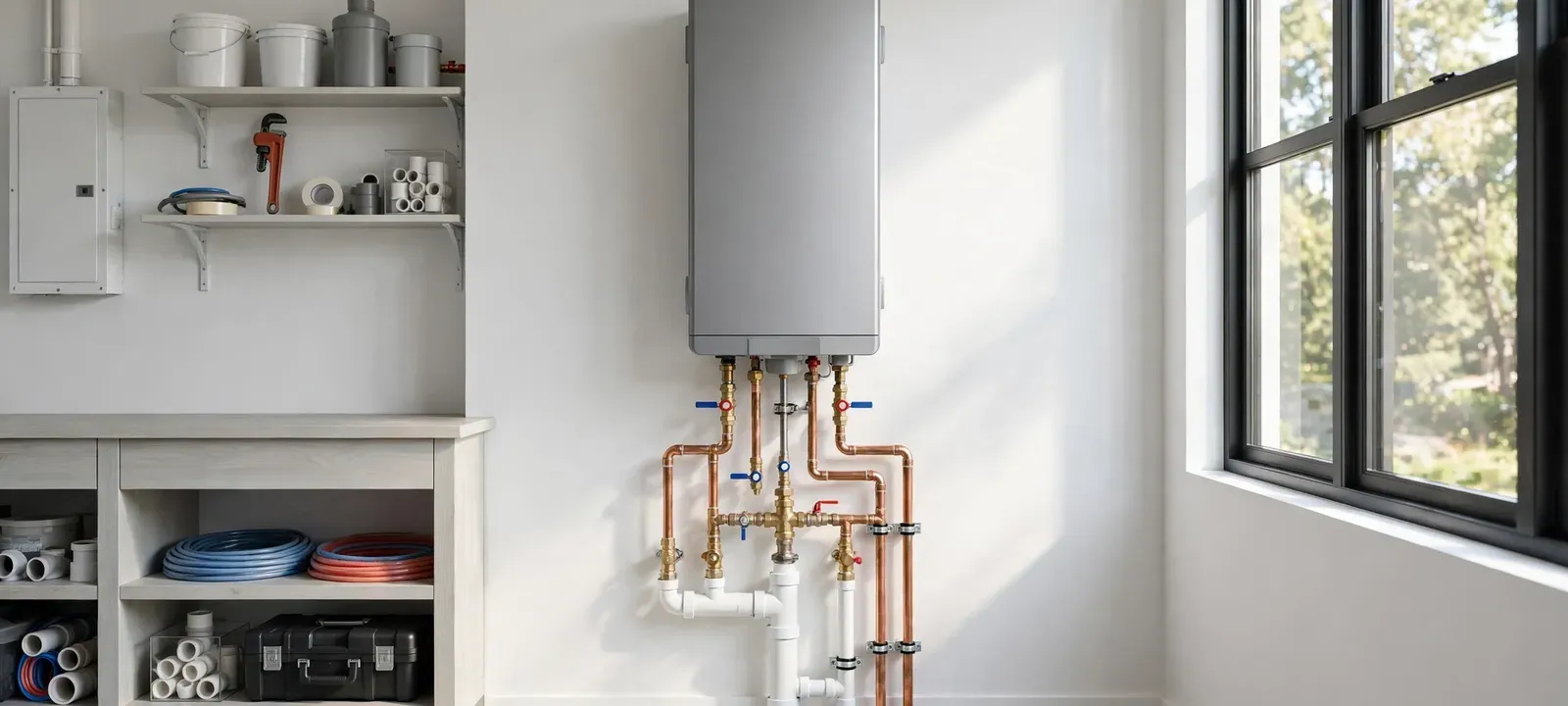
The benefits, one at a time
Each one has a catch worth knowing.
Endless hot water
The unit heats as water flows, so it does not run out. Flow is limited by the unit's rating.
Small footprint
It mounts on a wall and frees floor space.
No standby loss
A tank keeps water hot all day. A tankless unit heats only on demand.
Long service life
Many units are designed to last longer than a tank when maintained.
Less water damage risk
There is no large tank to burst, though pipe leaks still happen.
Tankless versus tank for a Minnesota home
Compare on what matters to you.
| Factor | Tankless | Tank |
|---|---|---|
| Upfront cost | Higher | Lower |
| Hot water supply | Continuous | Limited by tank |
| Winter inlet water | Colder water lowers output | Preheated storage |
| Maintenance | Descale on a schedule | Flush and anode rod |
| Power outage | Needs power | Gas tanks keep working |
See replacement for the standard tank option.
Local note: hard water and the gas supply
The City of South St. Paul reports typical hardness of about 18 grains per gallon, or 307 parts per million. The Minnesota Department of Health says water over about 7 grains per gallon may benefit from softening. Source type: city water FAQ and state health guidance.
Hard water scales the heat exchanger of a tankless unit, so you need a flush plan or a softener. Xcel Energy supplies gas here, and the line to your unit may need to be larger. Learn more on our water softener and filtration page.
Who benefits most
Households that run out of hot water with a tank, homes with little floor space and owners who plan to stay many years gain the most. A tankless unit also suits a bathroom addition, where a large tank would not fit.
It is a weaker fit for a household that runs several showers and appliances at once, unless you size up. Ask us to size for your peak use in the coldest month, not for an average day.
Questions to ask before you buy
Ask about the gas line size, the vent path, the descaling plan and the warranty. Ask who services the unit and how long parts take. Ask about an isolation valve kit that makes flushing simple.
If you live in Inver Grove Heights, where the city reports 20 to 22 grains per gallon, or Cottage Grove, at about 17 grains, hardness matters even more.
How to size a tankless unit
Sizing is about flow and temperature rise. Add up the flow of the fixtures you expect to run together, such as a shower at a time and a dishwasher, and note the temperature you want. Then check the incoming water temperature in your coldest month. The unit needs enough heating capacity to lift that cold water to your target at that flow.
Minnesota winters make this the key number. A unit that works fine in July can fall short in January. Ask the installer to size to the winter case, and ask what happens when two showers run together.
A simple maintenance schedule
These are typical intervals. Follow your manufacturer's guide.
| Task | Interval | Why |
|---|---|---|
| Descale the heat exchanger | About yearly in hard water | Scale reduces flow and efficiency |
| Clean the inlet filter screen | Every few months | Debris restricts flow |
| Check venting and intake | Yearly | Safe combustion |
| Inspect condensate drain | Yearly | Prevents backups on condensing models |
Isolation valves make descaling a short job.
Common misconceptions
Tankless does not mean unlimited hot water for any number of fixtures. It means continuous hot water within a flow limit. Tankless also does not remove the need for maintenance. It swaps flushing a tank for descaling a heat exchanger.
Finally, a tankless unit is not always cheaper to run. If your household uses very little hot water, the savings are small. If you use a lot, a tankless unit often helps. Ask for your own numbers, not an average.
Cost of ownership beyond the sticker price
Compare the purchase price, the installation work, the yearly maintenance and the expected life. A tankless unit usually costs more to buy and install, and then it asks for a flush each year. A tank costs less up front and wears out sooner.
Ask Xcel Energy and the manufacturer whether any rebates or incentives apply to your unit before you buy. Programs change, and we do not list any here. Also ask your insurer whether a tankless upgrade affects your policy. Some owners find that removing a large tank reduces their water damage risk, though the insurer decides what that means for your premium.
Sources for this page
Hardness comes from the City of South St. Paul's published water FAQ, and the softening threshold comes from the Minnesota Department of Health's guidance. Installation follows Minnesota Rules chapter 4714 and the Uniform Plumbing Code (UPC).
Questions about this topic
It can be, if you value space and continuous hot water and you will keep up the maintenance.
In hard water, at least once a year is common advice. Follow the manufacturer's guide.
No. It needs electricity even on gas models.
The city reports typical hardness of about 18 grains per gallon.
Often. We check before we quote.