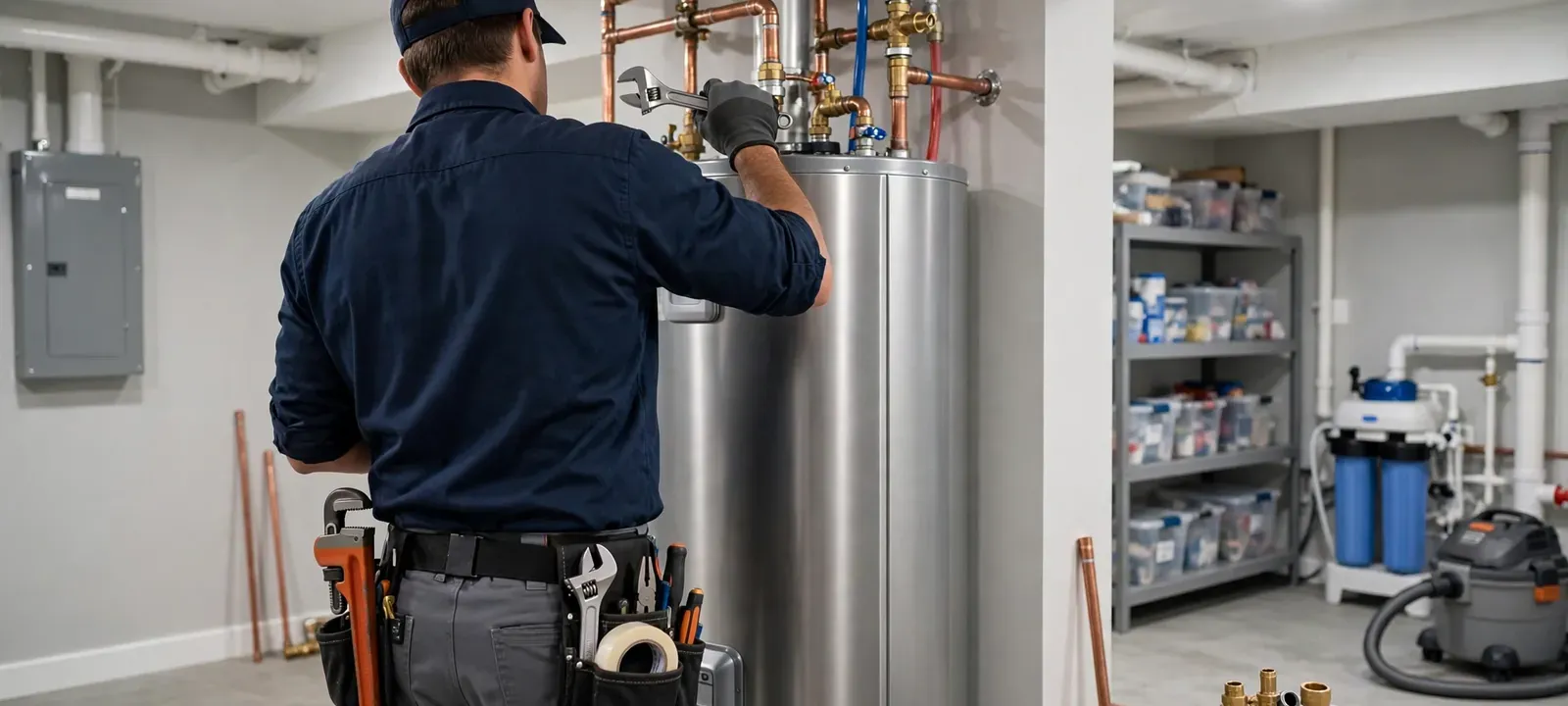
Line items to compare
Ask every company to break out these items.
| Line item | What to look for | Why it matters |
|---|---|---|
| Water heater | Brand, size, efficiency rating, warranty | The unit sets lifespan and fuel use |
| Labor | Hours or flat price | Tight spaces cost more |
| Venting and gas | New vent, new flex line, shutoff | Code and safety |
| Relief valve and discharge | New valve and pipe | Required safety device |
| Expansion tank | Included or not | Closed systems need one |
| Permit | Who pulls it and the fee | Compliance and resale |
| Haul-off | Disposal of the old tank | Often an add-on |
A quote that lumps everything into one number is harder to compare.
Tank versus tankless: the cost shape
A standard tank costs less to buy and install. A tankless unit costs more to buy and often more to install, because the gas line and the venting may need to change. The tankless then costs less to run if your household uses moderate amounts of hot water.
Neither is better in every house. See tankless water heaters for the case for on-demand heat, and water heater replacement if your tank has already failed.
Local note: permits, licenses and fuel
The City of South St. Paul lists water heaters among the residential plumbing permits available through its online permit system. The Minnesota Department of Labor and Industry runs a public license lookup to check a plumber. Source type: city permit page and state lookup.
Xcel Energy supplies natural gas in South St. Paul. If you smell gas at any time, leave and call Xcel at 1-800-895-2999 or 911. The city reports hard water around 18 grains per gallon, and hard water scales a new heater, so price a flush plan and consider a softener in the same visit.
Where the price moves most
Venting and gas work move the price more than the tank brand. Replacing an old atmospheric-vent heater with a high-efficiency unit may need a new vent. Moving the heater to a new place adds pipe, gas and venting.
Timing also matters. An emergency swap on a January night costs more than a planned install, because the call-out is higher and the selection is smaller. If your tank is ten years old and showing rust, plan the swap in spring or fall.
How to read a quote
Read for what is excluded. A low number that leaves out the permit, the expansion tank and the haul-off is not low. Ask for the warranty terms on the tank and on labor in writing, and ask who is responsible if the permit inspection finds a problem.
If you live in West St. Paul, note that domestic water permits go through St. Paul Regional Water Services. In Newport, inspections go through West St. Paul. A plumber who works in the area can explain which office applies.
What install day looks like
Knowing the sequence helps you judge a quote.
Drain and disconnect
The old tank is shut off, drained and disconnected.
Set the new heater
The new unit is placed, leveled and connected to supply lines.
Gas, venting or electric
Gas and venting or power connections follow code.
Fill, purge and test
The tank is filled, air is purged and the unit is checked for leaks and proper operation.
Cost over the life of the heater
The purchase price is one number. Fuel, maintenance and lifespan add up over a decade. A tank flushed yearly in hard water runs more efficiently and lasts longer than one that is never touched. An anode rod check around year four to six gives you a read on the tank's remaining life.
If you plan to stay in the house, compare the total over ten years, not the lowest first price. A slightly more expensive tank with a stronger warranty and a softener upstream can cost less over time in a hard water city.
Warranty terms to compare
Tank warranties often list a long number of years, but they usually cover the tank only and not the labor to replace it. Parts warranties are shorter. Labor warranties come from the installer and vary widely.
Read what the warranty requires. Some manufacturers require professional installation, a relief valve and yearly maintenance. Ask whether the warranty transfers if you sell the house, and keep the receipt and the model and serial numbers where you can find them.
Sources for this page
Permit and license details come from the City of South St. Paul and the Minnesota Department of Labor and Industry. Hardness comes from the city's published water FAQ. Gas safety numbers come from Xcel Energy. Installation follows the Uniform Plumbing Code (UPC) as adopted in Minnesota Rules chapter 4714.
Questions about this topic
Differences in unit, venting, permits and what is included explain most of the gap. Compare line by line.
The city lists water heaters on its residential plumbing e-permit list. Ask before you install.
Minnesota allows owners to do plumbing in their own home unless a local ordinance forbids it. Gas work needs care.
A like-for-like swap often takes a few hours.
With hard water, it is worth pricing. Ask for it as a separate line item.