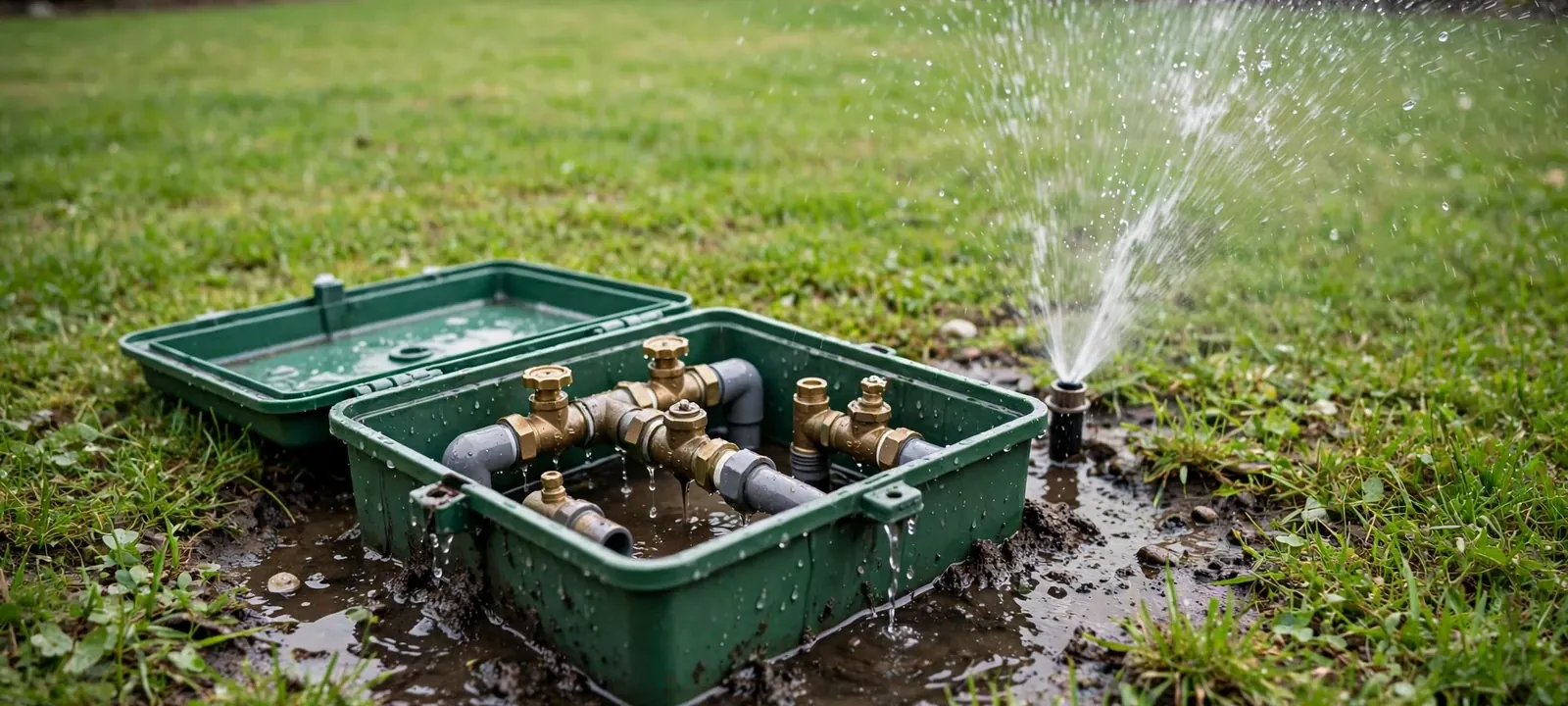
Find the leak in four steps
This routine works for most residential systems.
Run a meter test
Turn off the water inside, run no zones and watch the meter. If it moves, water is going somewhere.
Run each zone
Start the controller and walk each zone, looking for geysers, soggy spots and low pressure.
Check the valve boxes
Open the boxes. Standing water in the box or hissing at a valve means a failed diaphragm.
Mark and isolate
Flag wet spots. Shut the zone valve to confirm.
Where sprinkler leaks hide
Each part fails in a typical way.
| Part | Typical failure | What you see |
|---|---|---|
| Spray head | Cracked body or worn seal | Water seeping around the head |
| Riser or swing joint | Broken by a mower or by frost | Geyser or soft ground |
| Zone valve | Stuck diaphragm | Zone weeps with controller off |
| Buried pipe | Cracked by frost or roots | Wet stripe in the lawn |
| Backflow assembly | Failed seal or freeze damage | Water spitting at the device |
A zone that runs on its own may have a failed valve and not a controller problem.
Spring startup is when leaks show
Freezing water expands and can split fittings, valves and backflow assemblies. You often cannot see the damage until the system is pressurized in spring. Open the main slowly, run each zone and look.
A fast pressure drop on startup, a hiss at the backflow device or water bubbling on the lawn are all signs. If you find a split in the main supply pipe feeding the system, shut the supply and call. Our burst pipe repair team handles those.
Local note: frost depth, winterizing and backflow tests
Minnesota sets frost depth at 3.5 feet for Dakota County, which is far below where most irrigation lines run. That is why systems here are drained or blown out with compressed air each fall. Source type: Minnesota Rules 1303.1600.
Backflow assemblies on irrigation must be tested by a tester certified by the Minnesota Department of Labor and Industry. Some utilities require periodic testing and can shut off service if it lapses. Ask the City of South St. Paul's utility what it requires for your address. For testing and other commercial needs, see commercial plumbing.
What a repair costs you in water
A leaking head wastes water in small amounts, but a buried leak can run constantly and show up on your bill. The bill is a clue. If the usage line jumps in summer without a change in habits, test the system.
Fixes range from a cheap spray head to a buried pipe repair. The cheaper fixes you can often do yourself. For mainline breaks or a leak you cannot find, a plumber with locating equipment saves a lot of digging. We cover Mendota Heights and Cottage Grove as well as South St. Paul.
Fall winterizing checklist
A good shutdown prevents most spring leaks.
- Turn off the water supply to the system
- Drain the backflow assembly and open its test cocks
- Blow out each zone with compressed air in the right sequence
- Leave the controller in rain mode for winter
- Insulate exposed pipe above ground
A pressure and flow check in spring
Open the supply valve slowly. A fast open sends a hammer through the system and can crack fittings. Note the pressure on a gauge if you have one, then run each zone and compare the spray pattern. A weak zone often has a leak upstream of the heads.
If a zone will not hold pressure, close the valve and watch the gauge. A steady drop shows a leak between the valve and the heads. This is the point where a locating tool saves you from digging the whole lawn.
Repair a head or replace the zone
A single cracked head or a broken riser is a quick repair. Replace the part, check the seal and reset the height so the head sits flush with the lawn. If several heads on one zone leak or the pattern is uneven, the pipe may be failing, and the zone is worth looking at as a whole.
Old heads wear out at different speeds, so replace a few at once when you open the system in spring. Match the nozzle type so the zone keeps even coverage. If you cannot find which head leaks, run the zone with the cover off and watch for a pool at the base.
Sources for this page
Frost depth comes from Minnesota Rules 1303.1600. Backflow tester certification is a Minnesota Department of Labor and Industry requirement. Utility testing rules vary, so check with the City of South St. Paul. Backflow assemblies follow the Uniform Plumbing Code (UPC) as adopted in Minnesota.
Questions about this topic
A meter that moves with the house water off, soggy spots, low pressure in a zone or a bill that jumps in summer.
Heads and risers are simple. Buried mainline breaks and valve problems are harder.
Before the ground freezes, usually in October. Check the forecast.
A tester certified by the Minnesota Department of Labor and Industry.
Ask the City of South St. Paul's utility. Requirements can vary by utility and property.