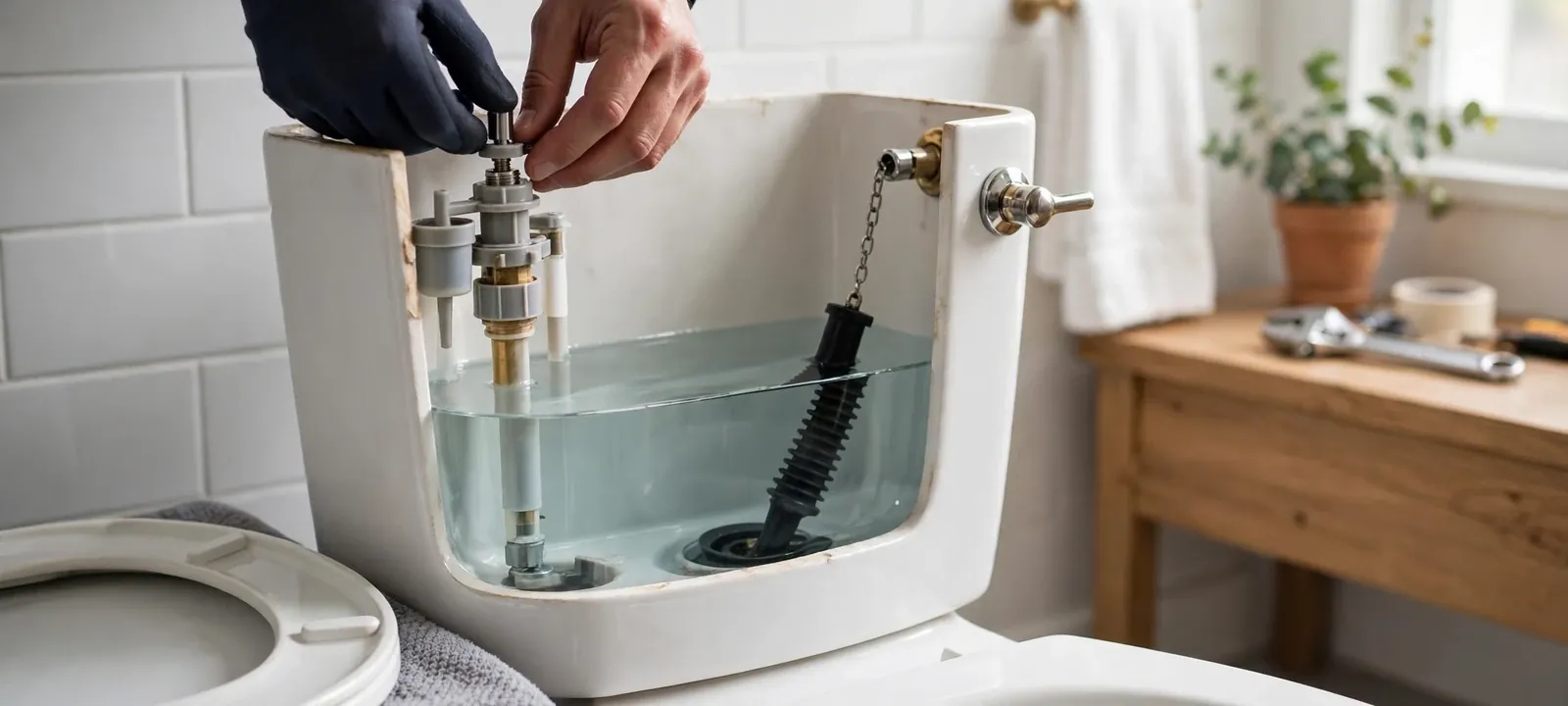
Start with the symptom
Match what you see to the likely part. This saves a trip to the hardware store.
| Symptom | Likely part | DIY level |
|---|---|---|
| Tank refills every few minutes | Flapper not sealing | Easy |
| Hissing or constant fill | Fill valve | Easy to moderate |
| Weak flush | Clogged rim holes or low tank water | Easy |
| Water around the base | Wax ring or loose bolts | Moderate |
| Toilet rocks | Flange or loose closet bolts | Moderate to hard |
| Repeated clogs | Drain issue | Call a plumber |
If you are unsure, shut the supply valve and stop. A wrong guess on a toilet can leave water on the floor.
Fix a running toilet in four steps
This is the most common repair, and the cheapest.
Turn off the water
Close the supply valve behind the toilet by turning it clockwise, then flush to empty the tank.
Inspect the flapper
Lift it out. If the rubber is soft, warped or coated in mineral crust, replace it.
Check the chain
The chain needs a little slack. Too tight holds the flapper open, and too loose lets it snag.
Test and adjust
Turn the water on, flush, and watch the tank. The water should stop a half inch below the overflow tube.
Weak flush and phantom flushes
A weak flush often comes from mineral deposits that block the small holes under the rim. A mirror and a small brush will show you if they are crusty. Vinegar and a stiff wire clean them. Low water in the tank also weakens the flush, so check that the fill level reaches the line on the tank.
A toilet that seems to flush by itself is leaking slowly past the flapper. The tank drops until the fill valve kicks on. This wastes water silently. Add a few drops of food coloring to the tank and wait fifteen minutes without flushing. Color in the bowl means the flapper needs to be replaced.
Leak at the base: the wax ring
A wet floor at the base usually means the seal under the toilet has failed. The fix is to shut the water, drain the tank, disconnect the supply, remove the bolts and lift the toilet straight up. Scrape off the old wax, check the flange, set a new ring and lower the toilet back with care.
Do not skip the flange check. A flange that is cracked, rusted or below the finished floor will keep leaking. If you find damage or a soft subfloor, stop and call. Our toilet repair and installation team handles flange repair every week.
Local note: South St. Paul water and toilet parts
The City of South St. Paul says its well water is typically 18 grains per gallon, or 307 parts per million. That is hard water. Minerals build on flappers and fill valve seals, and they can prevent a flapper from closing even when the rubber looks fine.
So in South St. Paul, a rinse or a replacement of the flapper may fix what looks like a bigger problem. Source type: the city's published water FAQ. If you want to know what hard water does to the rest of your plumbing, see water softener and filtration.
When a toilet problem is a drain problem
If the toilet clogs again right after you plunge it, or if other fixtures gurgle when you flush, the toilet is fine and the drain is not. A partial blockage in the branch or the main shows itself in the toilet first because it is the largest fixture.
In that case a drain cleaning visit is the right next step. If your home is in West St. Paul, our West St. Paul service covers the same repairs, and Mendota Heights is on our map too.
Tools and parts to have on hand
Gather these before you shut the water, and the job goes faster.
- A new flapper that matches your tank style, or a universal one
- An adjustable wrench and a pair of pliers
- A sponge and a small bucket for the tank water
- A new wax ring with bolts if the base leaks
- A flashlight and old towels
Sources for this page
Hardness comes from the City of South St. Paul's published water FAQ. Plumbing work follows Minnesota Rules chapter 4714, built on the Uniform Plumbing Code (UPC). Parts guidance follows common manufacturer practice.
Questions about this topic
A toilet that leaks slowly can waste many gallons a day. The exact number depends on the leak, but even a quiet run adds up on a water bill.
Yes. It is one of the simplest repairs. Match the flapper style to your tank, and make sure it seals flat.
A toilet that rocks, a base that keeps leaking after a new ring or visible cracks around the floor ring all point to the flange.
It crusts parts and clogs rim holes. In South St. Paul, where the city reports around 18 grains per gallon, a yearly look at the tank parts is worthwhile.
Replacing parts does not. The city lists some plumbing work for permits, so check with its Building Permits and Inspections office before major changes.