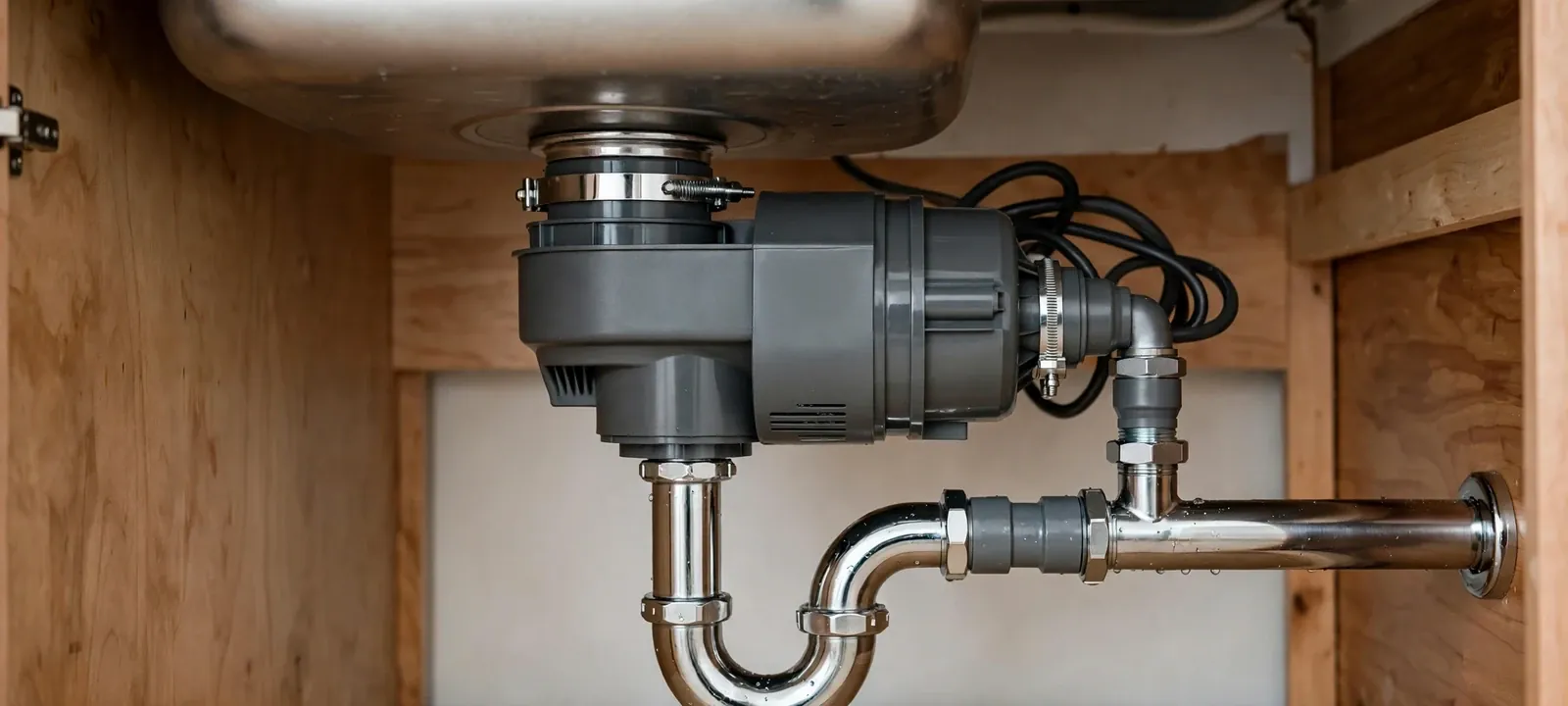
Swap or first install
The difference in effort is large.
| Job | Difficulty | What makes it harder |
|---|---|---|
| Swap for the same brand | Moderate | Mounting ring often reuses |
| Swap for a different brand | Moderate to hard | Mount, plumbing alignment |
| First install under a sink | Hard | New outlet or switch, new drain plumbing |
| Dishwasher hookup | Moderate | Knockout plug and hose routing |
If you do not already have a switch and outlet under the sink, call an electrician or a plumber.
The installation steps
These apply to most continuous-feed models.
Cut power and remove the old unit
Switch off the breaker and unplug. Disconnect the drain and the dishwasher hose.
Mount the flange
Seal the sink flange with putty, tighten the mounting ring and clean off excess putty.
Hang the disposal
Lift the unit onto the mount and lock it. Connect power.
Connect the drain
Attach the discharge pipe to the trap and the dishwasher hose. Remove the knockout plug if you have a dishwasher.
The pitfalls we see
The knockout plug is the classic mistake. If you hook up a dishwasher hose without removing the plug, the dishwasher will not drain into the disposal. Remove it before you mount the unit, and fish out the plug piece so it does not sit in the grinder.
The other common mistake is a mismatched drain. Disposals have a side outlet at a set height. If the trap arm is too low or too high, you have to rework the plumbing. Take photographs of the existing layout before you start.
Local note: the code and who may do the work
Minnesota's plumbing code, chapter 4714, covers how the drain and dishwasher connect. Minnesota Statutes section 326B.46 lets owners do their own plumbing in their own residence unless a local ordinance forbids it. Source type: state rule and statute.
The City of South St. Paul maintains the sewer main, and the line from your house is yours, so whatever goes down the disposal ends up in a line you own. Grease and fibrous waste are the main issues. For stubborn clogs after you install, see drain cleaning.
Is a disposal worth installing
A disposal helps with small scraps and is convenient. It does not replace the trash, and it adds load to your drain. Households with older cast iron or clay kitchen lines should be careful, since grease and starch collect in those pipes.
If you are in Mendota Heights or Cottage Grove, where owners are responsible for the lateral to the main, use the disposal gently, and keep an eye on the sink drain speed.
Choosing a disposal
Three choices matter more than the brand.
Motor size
Bigger motors grind tougher scraps and run quieter. A small motor is fine for light use.
Feed type
Continuous feed runs with the switch on. Batch feed runs only when a stopper is in place.
Grind stages and insulation
More grind stages and sound insulation raise the price and lower the noise.
Power, switches and the first run
Most disposals need a dedicated outlet under the sink, controlled by a wall switch or an air switch on the counter. If your sink has neither, adding one is electrical work. Hiring a licensed electrician is the safest route.
On the first run, switch on cold water, then the disposal, and watch under the sink for drips. Grind a few ice cubes to clear the chamber. Check the dishwasher connection by running a short cycle. A slow leak at the drain flange often shows only after a day, so check again.
What not to put down a disposal
These items cause most of the jams and clogs we see.
- Grease, oil and fat that cool and coat the drain
- Coffee grounds in large amounts
- Celery, corn husks and other fibrous stems
- Pasta, rice and potato peels that swell into paste
- Bones, fruit pits and anything hard
Break-in and care after the install
Run cold water before, during and for fifteen seconds after each use so scraps wash through the trap arm and out of the house line. Cold water keeps grease solid enough to be chopped and carried, where hot water melts it and lets it settle further down the pipe.
Clean the rubber splash guard with a brush every few weeks. Grind a handful of ice now and then to knock residue off the chamber walls. If the unit hums, leaks or smells, deal with it early. A small seal leak under the sink can rot the cabinet floor in a few months, and a failing disposal strains the motor until it quits.
Sources for this page
Code points come from Minnesota Rules chapter 4714 and the Uniform Plumbing Code (UPC). The owner-work allowance is Minnesota Statutes section 326B.46. Electrical points follow the National Electrical Code (NEC).
Questions about this topic
A swap takes a couple of hours. A first install can take most of an afternoon.
If there is no outlet or switch, yes or a plumber who handles it.
Check with your septic service. Disposals add solids to the tank.
The knockout plug is probably still in the disposal inlet.
State law allows owners to do plumbing in their own home unless local ordinance forbids it. Ask the city about permits.