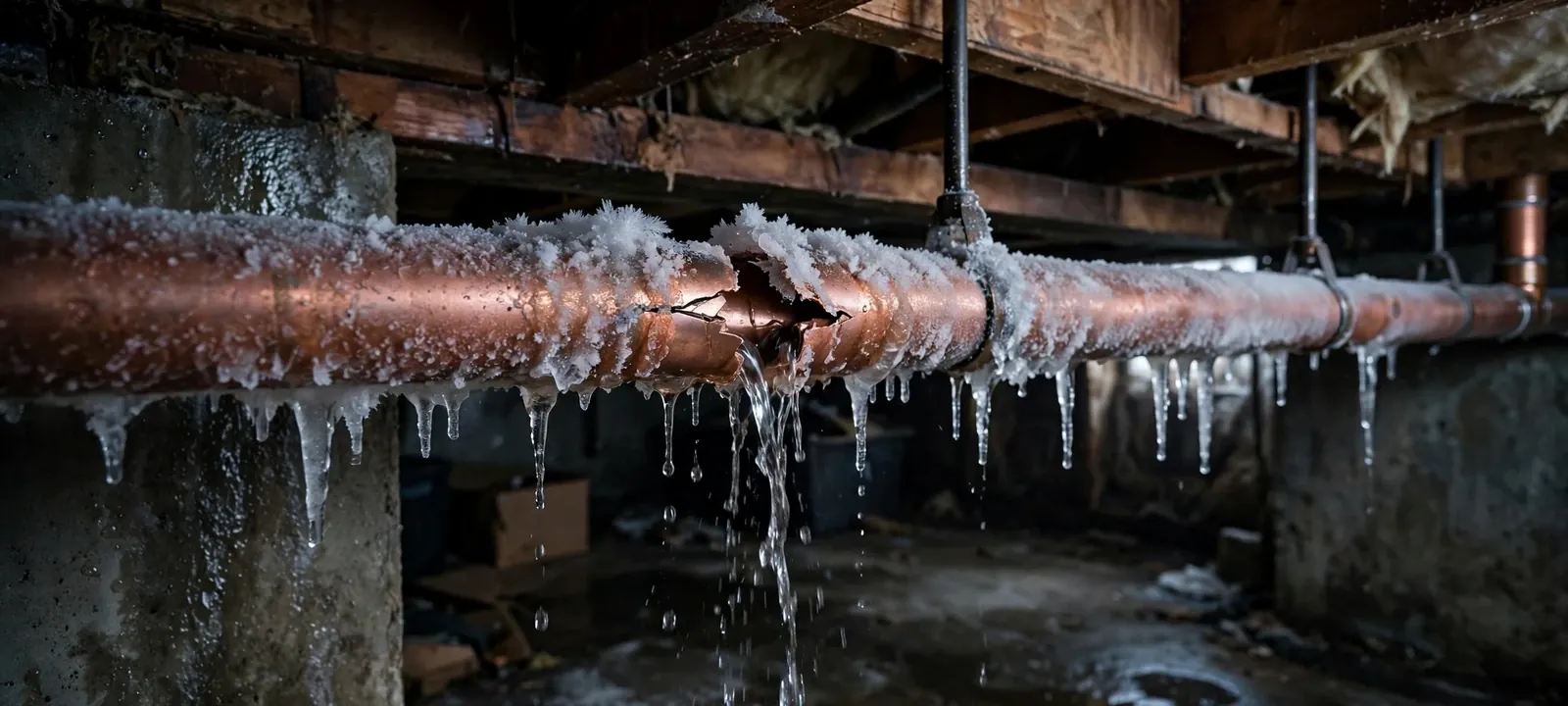
The cost drivers of a burst pipe
Every quote is a sum of these pieces.
| Piece | What it covers | Moves the price when |
|---|---|---|
| Emergency visit | Dispatch, shutoff, diagnosis | Night, weekend or holiday |
| Pipe repair | Cutting out the split and replacing the section | Pipe is copper, galvanized or inside a wall |
| Access | Opening drywall or ceiling | The pipe is hard to reach |
| Extent | One split versus several | A long run froze |
| Water cleanup | Drying and removal | Water reached finished surfaces |
Water cleanup is often a separate trade and a separate bill. Ask who handles it.
Why pipes split where they do
Ice forms in a pipe and expands. The pressure builds between the ice plug and a closed faucet, and the pipe wall gives way. The split often sits several feet from the ice itself. You find it after a thaw, when water flows again.
Exterior walls, garages and crawlspaces freeze first. That is why many Minnesota burst pipes turn up in places homeowners rarely check. If a pipe has frozen once, add insulation or heat before the next cold snap.
Local note: frost depth, code and what the cold weather rule does not cover
Minnesota sets frost depth at 3.5 feet for Dakota County, and the plumbing code requires buried water piping to sit at least 12 inches below local frost depth. Source type: state rules, Minnesota Rules 1303.1600 and chapter 4714.
The state Cold Weather Rule is about utility disconnection and does not cover plumbing repair or burst pipes. If your heat and power are on, you have no program to pay for the repair. Know that before the first cold night. For the repair process, see burst pipe repair.
What to do in the first hour
Time matters more than anything else.
Shut the main
Stop the water first.
Drain the lines
Open the lowest faucet and flush upstairs toilets.
Photograph
Take pictures before you clean.
Call your insurer and a plumber
Your insurer opens a claim. A plumber stops the leak.
Insurance and the bill
Homeowners policies often pay for sudden and accidental water damage, including damage from a burst pipe. They typically do not pay for the pipe itself. Policies may exclude damage when the house was left unheated or when you did not take reasonable steps to prevent freezing.
Read your policy for the freeze clause. Keep invoices from the plumber and the cleanup company. If you rent, call the landlord first. If you own a rental in West St. Paul or Newport, the same policy questions apply.
Ways to prevent a repeat
Insulate exposed pipes, seal drafts around pipes that pass through exterior walls and open cabinet doors on very cold nights. Let a small stream of water run in the coldest lines during a hard freeze. Disconnect hoses in the fall.
If a whole section keeps freezing, ask a plumber about rerouting or repiping. A one-time fix beats a yearly repair.
Thaw safely, or stop and call
The wrong thaw can turn a frozen pipe into a fire or a flood.
| Method | Safe? | Notes |
|---|---|---|
| Hair dryer on a low setting | Yes | Work from the faucet end toward the frozen part |
| Warm towels on the pipe | Yes | Replace as they cool |
| Space heater aimed at the wall | Use caution | Keep it away from anything that burns |
| Propane torch or open flame | No | A fire risk, and it can melt solder joints |
| Hot water poured on a pipe | No | A sudden change can crack a pipe |
If you cannot reach the frozen section, or you see a leak, shut the main and call.
Plumber, restoration company or both
A plumber stops the leak and repairs the pipe. A restoration company dries the structure, removes wet materials and handles mold risk. Many burst pipe jobs need both, and the two bills are separate.
Ask your insurer whether it has preferred vendors or requires a particular process for the claim. Keep the plumber's invoice, which shows the cause and the repair, because the restoration company and the adjuster will ask for it.
After the repair: signs of hidden damage
Water finds its way into walls, floors and ceilings. After the plumber is done, watch for musty smells, bubbling paint, warped baseboards and stains that spread. These signs can show up days later.
If you see them, tell your insurer and your restoration company right away. A moisture meter can find wet material behind a wall. Early drying costs less than replacing drywall after mold takes hold.
Sources for this page
Frost depth comes from Minnesota Rules 1303.1600, and buried piping rules come from Minnesota Rules chapter 4714. The Cold Weather Rule statement reflects its scope as a utility disconnection rule. Repairs follow the Uniform Plumbing Code (UPC). Insurance points follow typical homeowners policy language.
Questions about this topic
It often covers sudden water damage but may not cover the pipe itself. Check your policy for freeze exclusions.
No. The Cold Weather Rule is about utility disconnections and does not cover plumbing.
At least 12 inches below frost depth, and frost depth is 3.5 feet.
Yes, with a hair dryer or warm towels and an open tap. Do not use open flame.
If water does not return after warming, call. A hidden split may be waiting for a thaw.