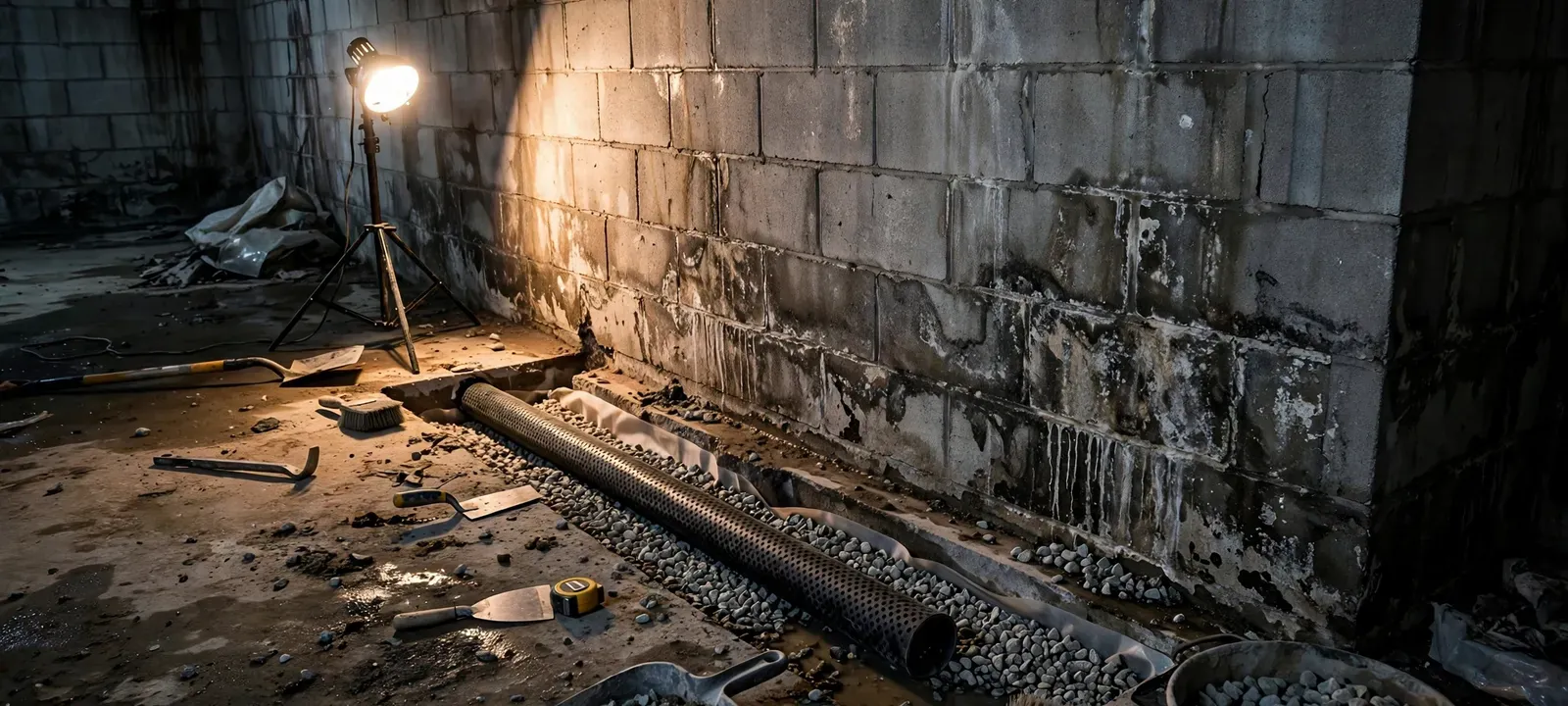
Cost drivers in a waterproofing estimate
A fair estimate lists each of these.
| Driver | What to ask | Why it moves cost |
|---|---|---|
| Water source | Where is the water entering | Surface runoff costs less than groundwater |
| Wall length | How many linear feet | Perimeter systems cost far more than spot fixes |
| Drain tile and pit | Type and size | Material and pump choices |
| Floor and finishes | Is there a finished floor | Demolition and restoration |
| Discharge | Where does water go | Must be outdoors, see sump pumps |
| Warranty | What does it cover | Terms vary widely |
If a company quotes before it looks at the basement, treat the number with caution.
Cheaper fixes first
Many wet basements start with simple causes. Downspouts that dump at the wall, soil that slopes toward the house and window wells that fill up all send water toward the foundation. Fixing those costs far less than any interior system.
A good company tells you which of these apply before it recommends drain tile. If an estimate skips the outside entirely, ask why.
Local note: the floodwall and your basement
South St. Paul's floodwall and levee were built in 1967 and protect the area from roughly I-494 to just north of Wentworth Avenue. The National Weather Service gauge at St. Paul recorded crests of 26.01 feet in 1965 and 23.76 feet in 2001. Source type: city and National Weather Service records.
That wall addresses river flooding. It does not keep rain runoff or groundwater out of a basement, so it should not shape your waterproofing decision. Sump pump discharge must go outside under city rules, not to the sanitary sewer. See basement waterproofing for the services we offer.
Older homes and what to expect
The city's 2040 planning documents say about 74 percent of homes here were built before 1970. Older block or poured foundations can seep at mortar joints, wall cracks and the cove joint. These are typical in the pre-1960 houses that make up a large share of the city.
Newer homes, such as the few built since 2000, tend to have better drainage details, so problems there often point to grading or a pump issue. Mendota Heights and West St. Paul homeowners face similar questions.
Insurance and the estimate
Standard homeowners policies generally exclude seepage and groundwater. A water backup endorsement may cover a sump or sewer backup, but not the waterproofing itself. Read your policy before you assume coverage.
Compare at least two estimates. Ask each company to put the cause of the water, the method and the warranty terms in writing.
What a proper site visit covers
A real estimate takes time on site.
Inspect the inside
Walls, floor cracks, cove joint, window wells and the sump pit.
Inspect the outside
Grading, downspouts, gutters and window wells.
Check humidity and history
When does water show up and how much.
Explain the cause
A written statement of where the water comes from and why.
Interior versus exterior: the shape of the cost
Rough comparison, without dollar figures we cannot source.
| Approach | Disruption | What drives the price |
|---|---|---|
| Interior drain tile and pit | Floor cut open inside | Length of wall, floor finish, pump |
| Exterior membrane | Yard dug along the wall | Depth, access, landscaping |
| Crack injection | Small | Number and length of cracks |
| Grading and gutters | Light | Area and materials |
Ask for the cheapest effective fix first, and then the full solution.
After the work: keep the basement dry
A pump needs a yearly test. A discharge line needs to be clear of ice and snow in winter. A dehumidifier keeps damp air from feeding mold, and a humidity reading of about half is a common target. Keep the downspouts extended and the window wells clean.
Waterproofing is a system, not a product. The best system fails if its pump fails or its discharge freezes, so ask about a battery backup and a discharge that drains away from the house.
Read the warranty before you read the price
Waterproofing warranties vary a great deal. Some cover the labor but not the pump. Some end if you sell the house, and some require yearly service visits. A transferable warranty can help when you sell, but only if you can read what it covers.
Ask what voids the warranty. A frozen discharge line, a power outage that stops the pump or a finished wall built over the drain can all create disputes. Ask for the terms in writing and ask who answers the phone when the pump fails at midnight.
Questions to bring to the first visit
Write down when water appears, how deep it gets and whether it follows rain, snowmelt or a high water table. Note any smell, any white mineral line on the wall and where the stains sit. This history helps a contractor tell surface runoff from groundwater in minutes.
Bring a copy of any earlier repair records, since a prior crack injection or a replaced pump changes the diagnosis. Ask the contractor to explain the cause in plain words before talking about price.
Sources for this page
Floodwall details come from City of South St. Paul records, and crest figures come from National Weather Service records for the St. Paul gauge. Housing-age figures come from the city's 2040 planning documents. Discharge rules come from the city.
Questions about this topic
It depends on the cause and the scope. We quote after we see the basement.
No. It protects against river flooding, not rain runoff or groundwater.
Generally not. Seepage and groundwater are usually excluded.
No. The City of South St. Paul requires it to discharge outside.
Extending downspouts and regrading soil.