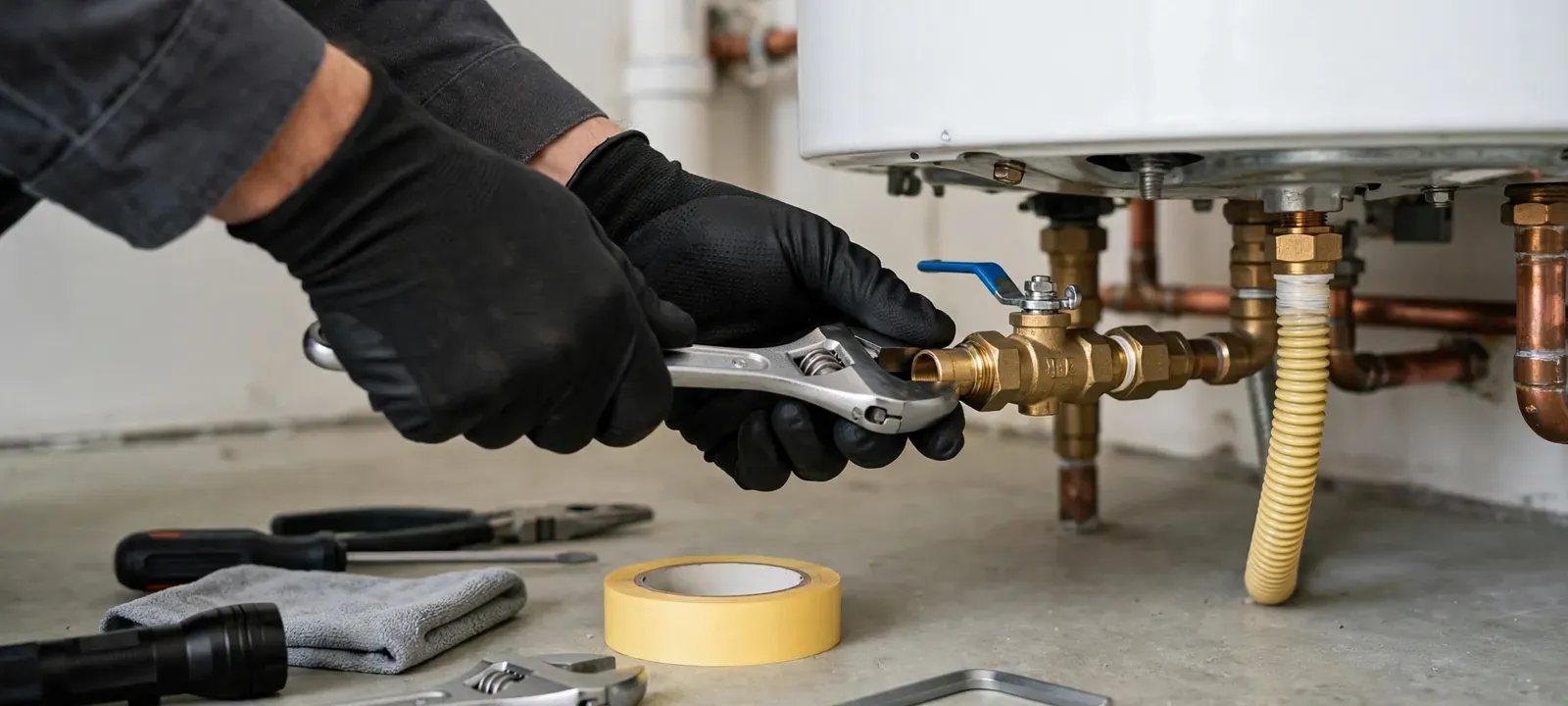
Gas safety comes first
Treat any gas smell as an emergency.
- Leave the house and take everyone with you.
- Do not flip switches, use phones or light flames inside.
- Call Xcel Energy at 1-800-895-2999 or 911 from outside.
- Do not return until the utility says it is safe.
Gas valve problems and what they mean
Most failures follow a pattern.
| Symptom | Likely cause | Typical next step |
|---|---|---|
| Pilot will not stay lit | Thermocouple or gas valve | Diagnose before replacing |
| No hot water, pilot out | Failed valve or draft | Check venting, then the valve |
| Water too hot or too cold | Thermostat in the valve | Replace the valve or the heater |
| Gas smell | Leak at a connection | Leave and call Xcel or 911 |
Replace the valve only after the thermocouple, the venting and the supply are checked.
Replace the valve or replace the heater
The valve is a repair part. The question is whether the tank around it is worth the money. A tank under about eight years old and free of rust is usually worth a new valve. A tank near the end of its life, or one that has been leaking, is not.
Hard water speeds up tank wear. If your heater has not been flushed in years, sediment may have damaged the tank bottom. Ask your plumber to check before agreeing to a valve. See water heater replacement for the other path.
Local note: licensing, relief valves and the gas supplier
Xcel Energy provides natural gas in South St. Paul. Minnesota's plumbing code, chapter 4714, includes rules for the temperature and pressure relief valve on a water heater in Minnesota Rules 4714.0504. Source type: utility contact page and state rules.
Check any plumber on the Department of Labor and Industry lookup. A gas valve swap is gas work, and it should be done by a licensed professional who tests for leaks afterward.
What drives the cost
Cost depends on the part price for your model, the time to diagnose, the labor to swap the valve and the leak test. A common brand has parts on the shelf. An older or rare model can take days.
After-hours calls cost more. If your heater fails on a Saturday night in January, a repair may be quoted next to a replacement. In West St. Paul and Inver Grove Heights, we handle both kinds of calls. We do not list a dollar figure because no local source publishes one.
How a technician diagnoses the problem
Replacing a valve without testing wastes money.
Check the supply
Confirm gas is reaching the heater and the shutoff is open.
Test the thermocouple
A weak thermocouple mimics a bad valve and costs far less.
Check venting
A blocked flue or backdraft can shut the burner down.
Test the valve
Only when the other parts pass do we replace the valve.
Questions to ask before you approve a valve replacement
Five questions protect your wallet.
- How old is the heater, and does it have rust or leaks?
- Was the thermocouple and venting tested first?
- Is the replacement part the same model or a universal fit?
- Will you leak test the connection afterward?
- What is the warranty on the part and the labor?
Signs the heater is the real problem
Rust at the base, water around the tank, a rumbling sound from heavy sediment and an age of ten years or more all suggest the heater is near the end. In that case a new valve fixes a small part of a bigger problem.
If the tank is sound, a valve is a reasonable repair. If not, the same money applied to a new unit gets you a warranty and better efficiency. Ask for both options in writing.
Habits that protect a gas water heater
Small steps reduce valve and burner failures.
- Flush the tank once a year to clear sediment
- Keep the area around the heater free of dust and stored items
- Set the thermostat at a moderate temperature rather than the highest setting
- Check that the vent pipe is firmly connected and not blocked
- Never store paint, solvents or gasoline near the heater
What to do while the heater is down
Close the gas valve to the heater if it is giving you trouble. Keep the cold supply open unless water is leaking. Use the stove to heat water for washing, and run it only while someone is in the kitchen. Never use a gas oven or stove to heat the room.
If the house is cold and the heater is the only source of trouble, you can keep the furnace running as usual. Call and describe what the burner and pilot are doing, and we will tell you whether it can wait for the next available visit.
Sources for this page
The relief valve rule is Minnesota Rules 4714.0504, within chapter 4714 based on the Uniform Plumbing Code (UPC). Gas emergency numbers come from Xcel Energy. License checks use the Minnesota Department of Labor and Industry lookup.
Questions about this topic
The pilot will not stay lit, the burner will not fire or the temperature swings. A technician tests the valve and the thermocouple.
Gas work carries risk. Use a licensed professional and leak test afterward.
Xcel Energy at 1-800-895-2999 or 911.
Parts carry a manufacturer warranty. Ask for labor terms in writing.
Yes. Minnesota Rules 4714.0504 covers relief valves.