The meter test
Do this in a quiet period when no one is using water.
Close everything
Shut off taps, the dishwasher, the washer and any irrigation.
Read the meter
Note the numbers and look for a small spinning dial or triangle.
Wait
Leave the house for fifteen minutes without using water.
Read again
Any movement means a leak.
Clues in the yard and house
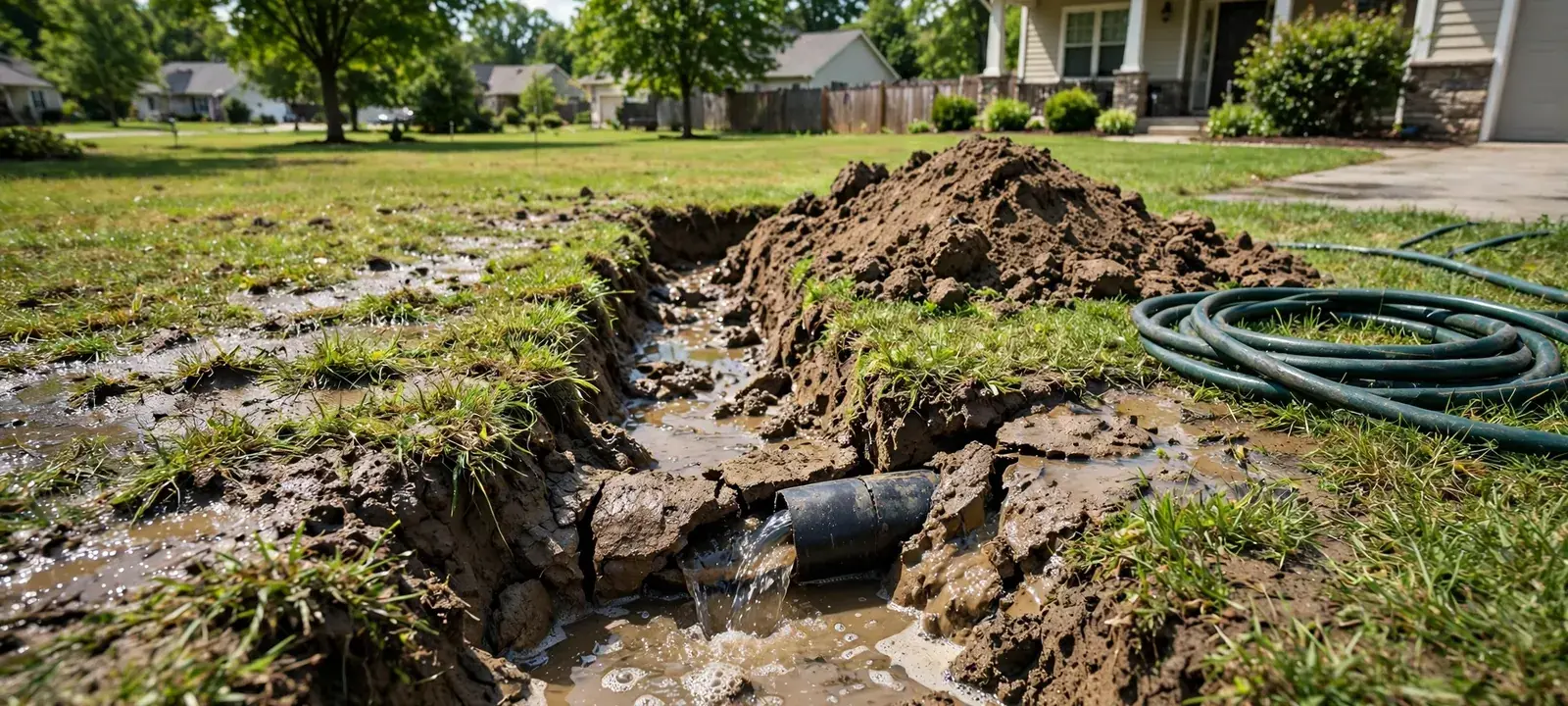
Buried leaks leave small hints.
Wet or green patch
A strip of grass that stays wet or unusually green in dry weeks.
Soft ground
A spongy spot or a small sink in the lawn.
Pressure drop
Weak flow at every tap, not just one.
Running sound
A faint hiss near the entry point or the meter.
Rising bills
A jump in usage with no change in habits.
Inside leak or buried leak
A meter that moves can mean either.
| Test | Result | What it suggests |
|---|---|---|
| Close the house main shutoff, then watch the meter | Meter stops | Leak is inside the house |
| Same test | Meter keeps moving | Leak is between meter and shutoff |
| Toilet dye test | Color in the bowl | Toilet flapper leak |
| Hose bib and irrigation off | Meter still moves | Likely buried line |
The house main shutoff is the key. Closing it splits the system in two.
Local note: who owns the line and what to do before digging
In South St. Paul, the property owner is responsible for the water service line from the building to the main. The city's lead inventory lists about 740 lead lines and about 175 galvanized lines that require replacement as of October 17, 2025, and private-side replacement may be at no cost with a signed agreement. Source type: city utility pages.
Before any digging, call Gopher State One Call at 811, which asks for at least 48 hours' notice. The state frost depth for Dakota County is 3.5 feet, and buried water piping must sit at least 12 inches below that, so lines run deep. See leak detection for how we locate leaks without opening the whole yard.
How a plumber finds the exact spot
Locating methods include acoustic listening devices that hear the sound of escaping water, pressure testing to confirm a line is losing pressure and tracer methods to follow a line. The method depends on the pipe material and the soil.
Plastic pipe does not carry sound as well as metal, so we often combine methods. Pinpointing the leak keeps the dig small. A good locate can turn a yard-wide excavation into a hole a few feet across.
What to do while you wait
If the leak is large, close the main shutoff and call. If it is small, you can leave the water on for a short time, but keep an eye on the meter and the yard. Do not dig by hand near utility marks without a locate.
The same steps apply in Inver Grove Heights and Cottage Grove. In Cottage Grove, city code 8-1-7 makes the owner responsible for the water line to the curb stop.
Reading your water bill for clues
Your bill shows usage over a period. Compare this month to the same month last year. A rise that does not match new habits, a new fixture or a guest is a signal. Winter usage is usually lower than summer, so a winter spike is more suspicious than a summer one.
Do not assume the meter reading on the bill is wrong. Utilities test meters on request, but a leak is a far more common cause of a spike. Run the meter test first, and call the city utility if the numbers still do not make sense.
Other causes of a moving meter
A moving meter is not always a buried line.
- A running toilet flapper that leaks into the bowl
- A leaking water softener or humidifier line
- A dripping hose bib or irrigation valve
- A water heater relief valve that is weeping
- An ice maker or filter line with a slow leak
What happens after the leak is found
Once the spot is marked, the repair depends on the pipe. A small break in good copper or plastic pipe is a short section replaced with new fittings. A break in an old galvanized or lead line is a reason to replace the whole line, since the pipe around the break is in the same condition.
That is also the moment to ask the city about its replacement program, so the work happens once. The excavation is backfilled in layers, and the surface is restored. The plumber should also check pressure afterward and leave the meter test result with you.
Sources for this page
Ownership and lead inventory numbers come from the City of South St. Paul's utility pages. Frost depth comes from Minnesota Rules 1303.1600, and buried piping depth comes from Minnesota Rules chapter 4714. The locate notice comes from Gopher State One Call. Repairs follow the Uniform Plumbing Code (UPC).
Questions about this topic
You can confirm one with the meter test. Finding the exact spot usually takes specialized equipment.
State code requires buried water piping to sit at least 12 inches below frost depth, and frost depth for Dakota County is 3.5 feet.
The city maintains the main. The owner is responsible for the service line from the building to the main in South St. Paul.
The city keeps an inventory and a replacement program. Contact it to check your address.
Often not. Service line wear is usually excluded, though some policies offer an endorsement.